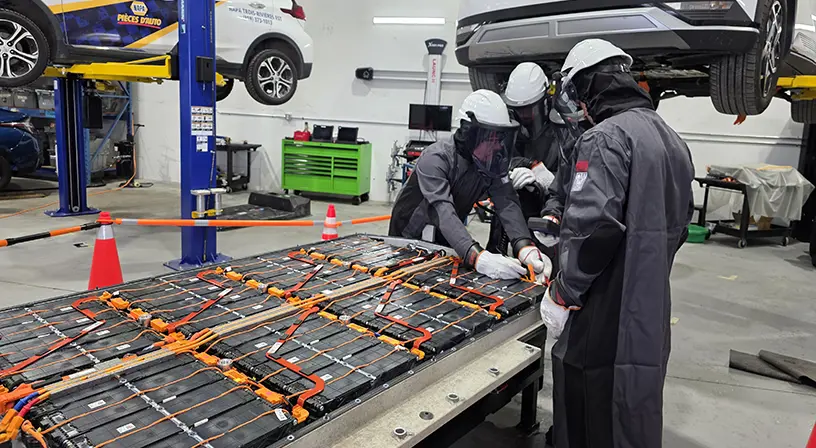
Can an EV Battery Be Repaired?
Yes, but not like a 12 V battery in a gas-powered car. The EV’s high-voltage battery pack comprises modules of cells managed by a battery management system (BMS) that monitors temperature, voltage, and charge distribution in real time.
A battery problem usually affects individual cells or modules, not the entire pack. An EV technician uses advanced diagnostic tools to pinpoint which modules are failing at the cellular level.
From there, the repair may involve replacing one or more of those modules rather than the entire battery — a meaningful difference when you consider that the battery accounts for roughly 30 to 40% of an EV's value.
However, not every battery pack is equally repairable. Your technician may recommend a full battery replacement. The main reason is battery balancing, i.e., ensuring that energy is evenly distributed throughout the battery.
When a battery isn’t balanced, some cells will store too much power, and others won’t store enough. Your BMS monitors this in real time and adjusts as needed. However, as the battery ages, the BMS may find balancing difficult.
EV batteries last a long time, though, often between 10 and 15 years.
How EV Battery Service Differs
The most important thing to understand about EV battery service is the voltage involved. Where a conventional car battery operates at 12 V, an EV's high-voltage battery pack operates between 400 and 800 V. Those voltages dangerously raise the risk for the person conducting the repairs.
You may have read that interrupting the circuit by removing or disconnecting the service plug makes the vehicle safe to work on. In theory, yes, and a trained technician will take this first step. However, the battery still holds a charge. This is called residual voltage or stored charge. Therefore, touching it can send a dangerous current through your body.
This is why you should never attempt an EV repair yourself, even if you’ve removed the service plug. Proper safety protocols, personal protective equipment (PPE) including Class 0 insulated gloves, and a thorough understanding of how to safely isolate high-voltage systems before any work begins are non-negotiable.
The Training Behind the Work
EV battery service is a specialized discipline that requires certification outside of standard automotive training.
The NAPA High Voltage training program is recognized by Natural Resources Canada in its national database of zero-emission vehicle technician training opportunities.
Automotive technicians pass through five levels of training to study the intricacies of servicing EVs and receive certification to service EVs. The first two levels focus on electrical training, and the remaining courses cover hybrid and electric vehicles.
Techs will have to meet a specific set of criteria, including accredited technical training, specialized equipment and tools, adherence to strict safety standards, and regular audits. They must also source parts from a certified NAPA store so NexDrive can ensure quality parts go into your repairs.
What a NexDrive Technician Can Do
When you bring your EV to a NexDrive facility, the technician will first attempt to diagnose your EV’s problem. The repair strategy then depends on what the diagnostics reveal.
In some cases, replacing one or a few faulty modules can restore full battery function. In others, deeper work may be required. Either way, your technician performs every step in compliance with high-voltage safety standards.
Participating NexDrive facilities also offer VoltScore, an exclusive battery health report that gives you a clear picture of your battery's condition. You would use this information to understand your current EV and for evaluating a used one before purchase.
All work is performed in compliance with manufacturer recommendations, which means your warranty stays intact.
The Right Shop Makes a Difference
Not every repair shop has the tools, training, or safety equipment to repair EV batteries. Choosing a certified facility isn't just about quality. You want reassurance that the work is done safely, correctly, and in a way that protects both your vehicle and everyone in the shop.
For EV battery diagnostics, repair, or a VoltScore battery health assessment, find a NexDrive facility near you.