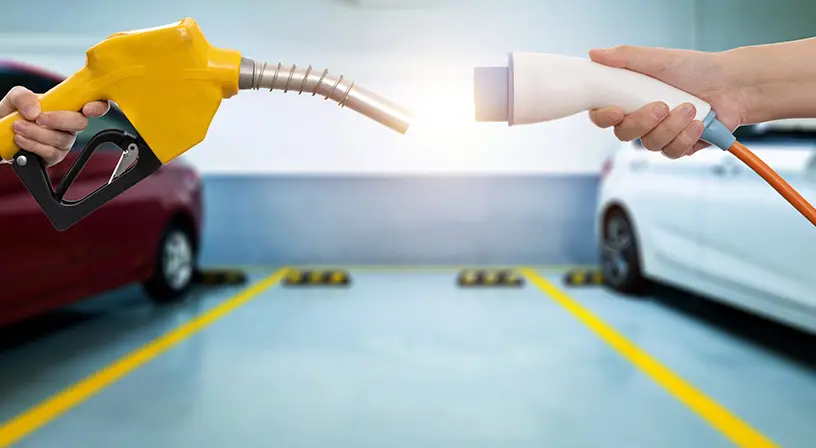
The Sticker Price Gap—EV vs. Gas Car Prices
EVs cost more upfront, but this gap narrows yearly as battery costs drop.
The federal EVAP rebate offers up to $5,000 per person for a battery electric vehicle (BEV) and up to $2,500 for a plug-in hybrid electric vehicle (PHEV), as of February 2026. The five-year program operates on a first-come, first-served basis.
The EVAP has a price cap, except on Canadian-made EVs. Vehicles manufactured outside of Canada must have a final transaction value of $50,000 or less to qualify. Read the full EVAP eligibility criteria.
Your province may offer additional rebates that can be combined with the federal EVAP. Always check availability in your province or territory before buying an EV.
What It Costs to Fill Up—EV Charging Costs vs. Gas
Electric vehicles cost considerably less to fuel.
For example, a minicompact may use 7.7 L/100 km, whereas its EV counterpart averages 2.1 Le/100 km. (Le/100 km = gasoline litres equivalent per 100 kilometres.)
At $1.50/L gasoline and $0.18/kWh electricity, driving 20,000 km costs about $2,310 for a gasoline vehicle and $684 for an EV. You’ll find more model-by-model comparisons in Natural Resources Canada’s fuel consumption ratings search tool.
Charging at home off-peak is the most cost-effective option. Public fast charging costs more per kWh but is still far cheaper than gas per kilometre.
EV vs. Gas Car Maintenance Costs
EV owners save significantly on maintenance, since EVs don’t require engine oil, spark plugs, or an exhaust system. CAA data puts the average EV vs. gas car maintenance cost savings at 40% to 50% for BEV owners.
Significant EV repairs can cost more than gas equivalents. Complex sensors, calibration systems, and heavier platforms due to the battery weight can push repair bills higher. This is why keeping up with regular EV maintenance matters: it can help protect the long-term savings.
The True Cost of Electric Vehicles—Total Cost of Ownership
Adding purchase price, fuel, and maintenance over time, EVs almost always come out ahead of gas vehicles. But the overall savings can take time.
A Clean Energy Canada study using 2022 data found that the EV version of the Hyundai Kona cost about $10,500 less to own over eight years than the gas version. Recent 2026 Canadian modelling by the same organization also shows EV savings around $22,200 over ten years compared to a comparable gas model, but this will vary by model and province. Most EVs break even within five years, depending on driving habits, province, and financial incentives.
Depreciation must be considered. EVs have historically depreciated faster than gas-powered cars. But this trend is improving as the used EV market and demand growacross Canada.
To help you plan out whether an EV is the right financial fit for you, use the CAA Car Cost Calculator to help model your own EV ownership scenario.
A Few Other Costs Worth Knowing
It’s important to know that EV insurance can cost more than gas car insurance. This is partly because EVs tend to have higher vehicle values and repairs can be expensive. The cost of car insurance for EVs vs. gas vehicles is narrowing as insurers gain more EV data, and some providers offer discounts for EV owners.
Certain Canadian provinces may also charge an EV levy to replace the fuel tax that owners of gas-powered vehicles pay at the pump. These fees partially offset fuel savings and are worth knowing before committing to an EV.
What About Emissions?
EVs produce zero tailpipe emissions, and can contribute even more to reducing greenhouse gas emissions. An electric SUV, for example, produces roughly three-quarters less greenhouse gas over its lifetime than a comparable gas model, averaged nationally. This includes everything from manufacturing (vehicle and battery) to scrapping.
Whether you already drive an EV, or are thinking about making the switch, keeping your EV properly maintained is what protects your investment for the long run. For all your ongoing EV service needs and expert advice, find a NexDrive location near you to book your next appointment.